


You spend years honing your craft, the big pitches, the late nights, and the middle management sagas.
Then the day finally comes when you're going to lead your own department.
You strut into your first leadership meeting full of confidence, which soon evaporates as you spend the next 2 hours squinting at charts that make no sense, decoding more acronyms than a 13-year-old's group chat.
Managing people is stressful, managing people and a revenue line is stressfull-er, and no one gives out a manual for that.
There's so much advice on here about how to run a business, and not so much about how to be half decent in one. So now I've served my time and left the 9-5; here's some of the stuff that helped me along the way.
Some of it is lived, some of it is learned, some of it's from being laughed out a room.
01 / 06
Numbers are scary, learn 'em fast anyway.

No matter your role in an agency or business, if you ask 'why' enough times on why you're being paid each month, it usually boils down to one of three things:
Making someone money
Saving someone money
Both
Meaning, most business decisions come down to cold hard cash in some way or another.
This only heightens as your conversations are actually tied to your revenue line. So if you're pushing for a new hire, tool, or even process; the business case should be front and centre.
"We've been 25% under resourced for the last 3 months" as you run through capacity figures, makes a much better argument than "Sebastian thinks he's really busy, can I have 40 grand for a new hire".
Opinions start debates, numbers end 'em.
The better you understand the numbers and how to have conversations around money, the easier it is to keep your team's (and your) mortgages paid.
If you're ever unsure, we've all been there, so I'd always just ask. Otherwise you'll be stuck gormlessly nodding as the FD mentions 'EBITDA' for the fifth time that week.
02 / 06
Measure outcomes, not output

It's very easy to be busy. It's actually quite difficult to be busy on the right stuff.
If I got a quid for every time I heard the word busy, I wouldn't be writing this at 21:53 on a Tuesday, or at the very least, I'd have the 40 grand to hire Sebastian's mate.
As you take the step up, the end goal matters more than the effort it took to get there. If your team updates are filled with stuff that's been made rather than the impact it had, you're celebrating your to-do lists.
And if you're reading this, I'm 96% sure you'll have some form of KPI, OKR or OMG to chase. Whatever it is, take a step back and ask yourself "Is this work actually helping me hit the business goals?"
If not, see the 'Learn to delegate fast' section.
03 / 06
Context will smack you well hard in the face

How much context you have in a business has a ceiling, and this is usually tied directly to your seniority.
Once you step up and see the numbers, some of it starts to (annoyingly) make sense. The client that's always been difficult? They make up a hefty chunk of revenue. The hiring freeze? A big contract's wobbling. The tool you were never allowed to use? It costs twice your salary.
The decisions you used to bitch about, are now the ones you're having to communicate to your team. My advice is be as transparent as you can, but remember context is shielded for a reason.
This isn't me saying you should agree with everything btw. Don't be afraid to argue upwards. Context works both ways; lived experience on the ground often doesn't make its way back up, be the bridge.
You're the translator between the business and your team. Get comfortable with it, cos it's half the job.
04 / 06
Manage down, sideways and up

I've told most of my hires this at some point, no matter what level they're coming in at.
Management brings alotta problems. When you face something for the first time it can seem MASSIVE, but after two or three spars with the same issue, you won't bat an eyelid.
My take: manage in three directions at once. It's a useful lens as you try and balance your sanity, your team's priorities and what the business needs.
Managing down
Be as open with your team as you possibly can, especially when you can't always give the full context. Explain what you can, own what you can't. You've often got to be the bullshit filter, so they can focus on their job.
The best managers I've had set team standards AND lived up to them. Don't preach what you don't practice, your team will soon work you out.
Managing sideways
Leadership is lonely at times. You often have to put distance between you and your team, most of your time is spent firefighting and problems are yours to own and solve.
The people around you are fighting the same fight, so show up for them, lean on 'em, swap notes, even have an occasional moan when you need to.
Managing up
There's problem solvers and problem sharers. Unfortunately, when you're green, it's easy to become the second one. Always try and bring a decision, even if it's the wrong one.
When you've got the big shiny title and the tax man is taking even more of your money, you're paid to own and solve shit, not to be a middleman with a megaphone.
05 / 06
Get comfortable having uncomfortable conversations

I've never regretted giving direct feedback fast, but I have regretted leaving it a little too long.
The latter will eventually impact your team members, your client relationships and your own sleep pattern. So sometimes it's best just to suck it up, put your big boy (or girl) pants on and tackle things head on.
This goes up as well as down. There's no point having tough conversations with your team if you can't return the favour with your manager.
5 minutes of awkwardness will save you 5 months of tiptoeing.
The wider team will respect you for it. And most of the time, the person on the receiving end will too.
06 / 06
Learn to delegate fast
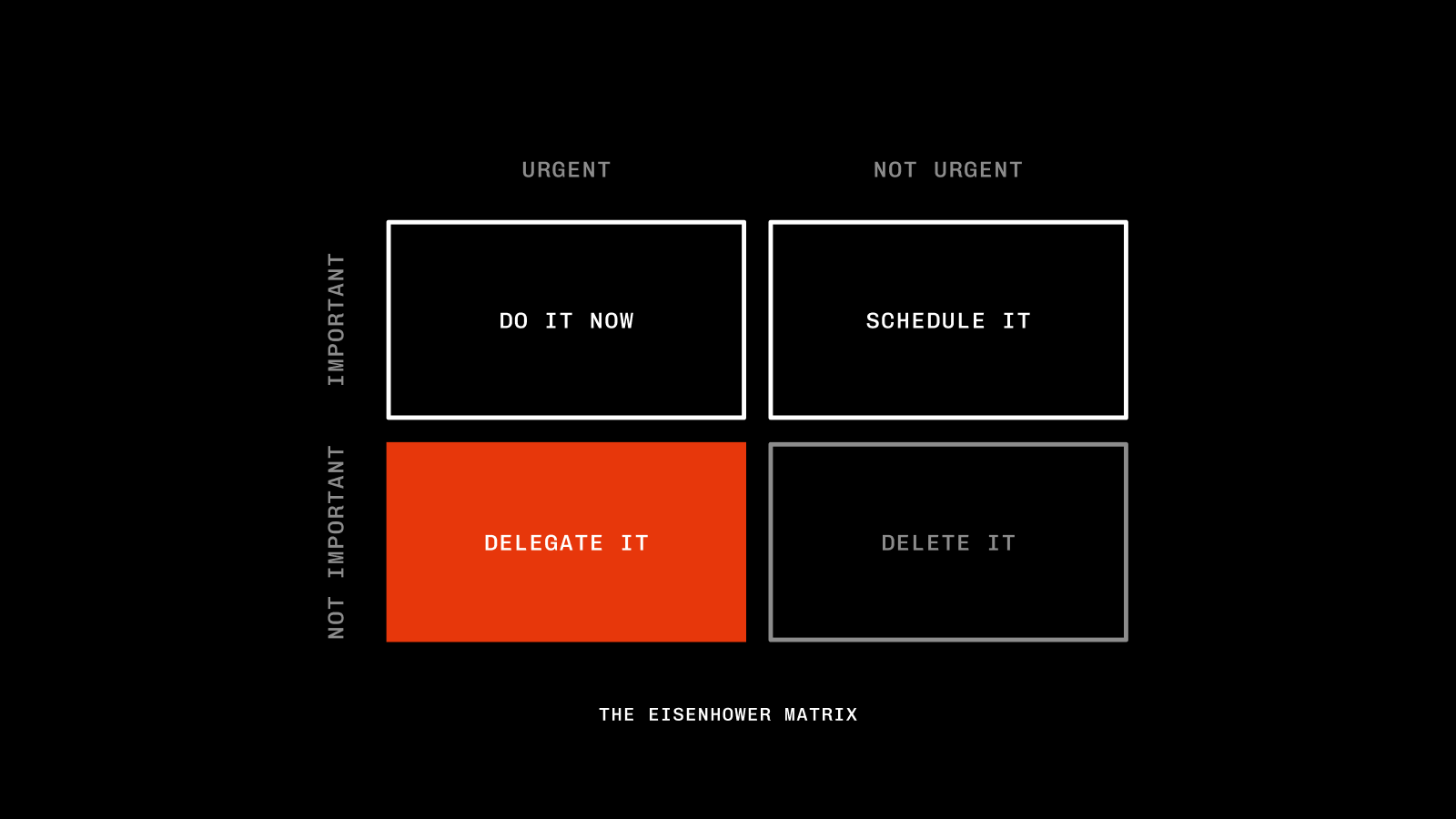
My mate Eisenhower has the majority of this one covered.
Being able to delegate effectively gives you the wiggle room you need to work on stuff that only you can do.
It's very easy to become your own bottleneck when you're leading a team, and if stuff can't move forward without you, it's gonna be one hell of a long ride.
Most people don't delegate cos they think the person won't hit their standards. And being honest, if you're delegating down they probably won't. But if delegating gets you 75% of the way there and 90% comes with 10 minutes of feedback, you've bought yourself back valuable time.
Make it easy for 'em. Keep your briefs clear: what you need, when you need it by and to what standard.
A vague brief gets vague work, and that's on you, not them.
Leadership ain't for the weak, but it can be very, very rewarding.
Watching someone you hired nail their first pitch or smash their first QBR often trumps the 9,000 yearly mentions of EBITDA.
So strut into that first meeting, mess up, have fun. We're all making it up as we go along anyway.